
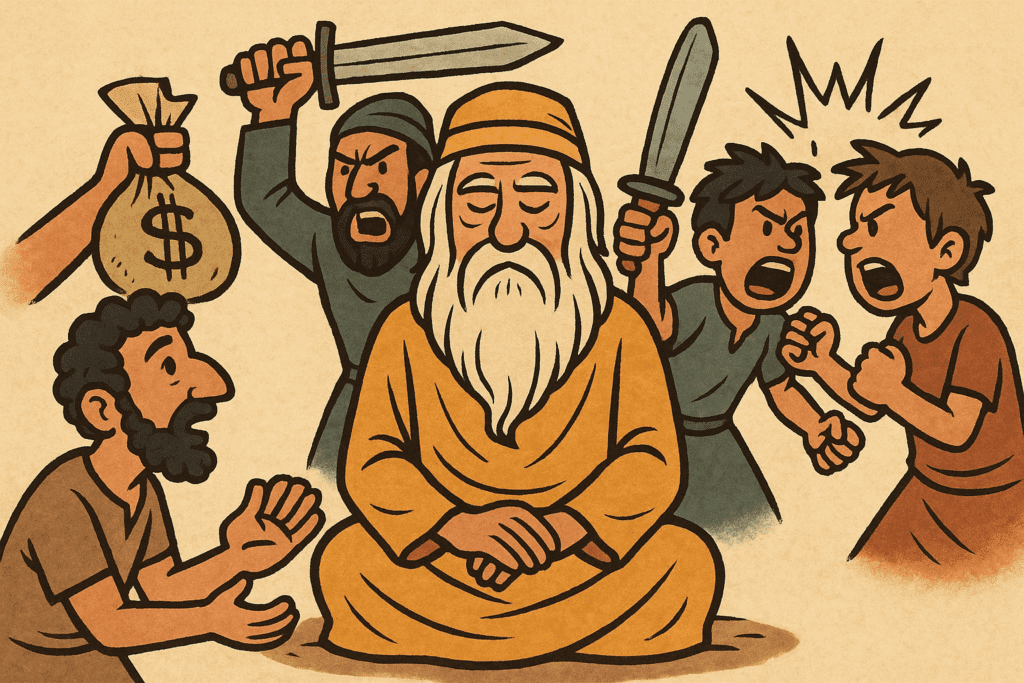
Yaakov’s Final Test– Rabbi David Ziering
The parsha begins, “Vayeishev Yaakov…”—Yaakov sits in the land where his fathers sojourned. The Torah could have said that he sojourned, yet it highlights the contrast: his fathers wandered, but Yaakov wants to settle.
Rashi explains that Yaakov finally wished to rest. After all the troubles with Lavan, after the terror of Esav, he longed for calm. And Hashem responds with a thunderbolt: “So you want to retire? Then I will bring upon you the challenge of Yosef.”
Because in this world, there is no retirement from holy work. As the Talmud teaches (Iyov; Sanhedrin 99b), man was created to toil—and not just any toil, but constant, unending spiritual work. The pasuk says the words of Torah should never leave our mouths. Human life is built for ongoing effort.
Seen this way, Yaakov’s life contains three great trials:
1. The Lavan Test – The Smiling Destroyer
The Haggadah says that Lavan was even worse than Pharaoh—he didn’t merely want to kill us; he wanted to uproot us entirely. His danger was subtle and seductive: assimilation, blurred identity, “what’s mine is yours and what’s yours is mine.” Switch the sheep, switch the wives—everything becomes mixed. It’s all the same “white” “lavan”.
Yaakov fights Lavan by separating himself, separating the sheep, and ultimately separating his destiny. This mirrors the spiritual threat of Chanukah—the Greek attempt to Hellenize, not murder.
2. The Esav Test – The Sword at the Door
Esav wants to kill Yaakov. Pure physical threat. This parallels Purim, where Haman’s decree targeted our bodies.
3. The Yosef Test – The Pain from Within
The most difficult challenge: family. Children. The heartbreak that does not come from enemies outside but from those closest. This final struggle is the one whose victory will only fully be celebrated at the Geulah. Until then we have Tisha b’Av—the still-open wound of internal division.
The Hidden Truth of Sefer Bereishit
From Parshat Vayeishev to the end of the book, it seems we’re reading the story of Yosef—and maybe Yehuda. But beneath the surface it is really the final chapter of Yaakov Avinu’s life-work. The parsha even signals this by calling it “the dwelling of Yaakov,” and Vayechi ( Last parsha of Bereishit) ends with Yaakov’s blessings.
The story unfolds through the children, but the architect behind the scenes is Yaakov. This is the stage of life when a person has fought their big battles, raised their family, and now—subtly, quietly—faces the deepest test: shaping the next generation.
There is no retirement.
We see Yaakov’s fingerprints everywhere:
The Coat of Many Colors
Why give Yosef a garment that could provoke jealousy? Yaakov is confronting the Achilles heel of Jewish history: sibling rivalry. From Kayin and Hevel through Yishmael and Yitzchak, Esav and Yaakov—jealousy tears families apart and destroys Temples.
Yaakov chooses to expose the issue early. Better to bring tension to the surface than to let it rot underground. By highlighting different strengths—something revealed later in the individual blessings—he begins to teach a radical idea: siblings can be different without becoming enemies.
His strategy works. Bereishit ends with Ephraim and Menashe, two brothers who never fought, even when the younger received the greater blessing. That is why we bless our children every Friday night to be like them—they succeeded where so many others failed.
VaYema’en – He Refuses to Give Up
Yaakov refuses to be comforted over Yosef. The word vayema’en echoes later when Yosef refuses Potiphar’s wife. Yaakov holds on to the belief that his son lives; that devotion gives Yosef the inner strength to hold on to his integrity.
Sending Binyamin Only With Responsibility
Yaakov allows Binyamin to go only when Yehuda takes full responsibility. He is waiting to see the brothers transform—teshuvah in action. According to Rashi, Yaakov even hopes that Yosef may yet return.
Again, the hidden hand of the father is guiding the future.
What Yaakov Planted in Us
When a parent advises a grown child, they are no longer the main character on the stage, but they are still shaping the entire play. That is Yaakov’s final test: not his own survival, but whether his children will become a unified nation.
The Talmud says Hillel obligates the poor, and Rabban Gamliel obligates the wealthy—meaning each proves that Torah can be lived in their condition. Yosef obligates anyone struggling with temptation; he placed within our spiritual DNA the capacity to overcome desire.
And Yaakov?
Yaakov implanted in us the ability to love our brothers, to see the good in each other, to build a nation not of identical people but of harmonizing strengths.
That is the final test of Yaakov Avinu.
And it is the test that still echoes in Jewish life today.